

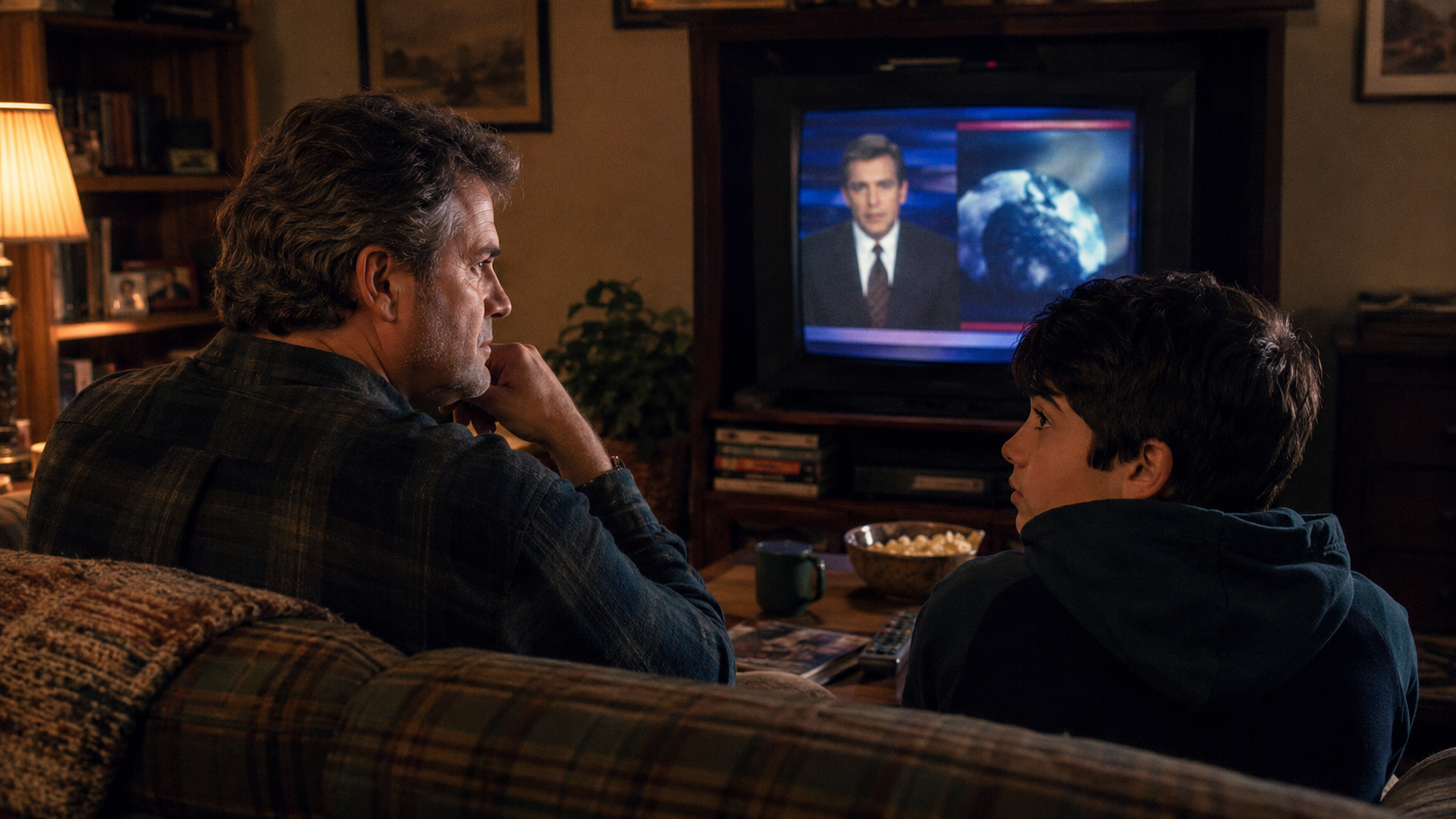
For nearly thirty years, I have occasionally watched the news with my dad and found myself returning to the same uneasy thought.
What I was watching seemed like the start and ongoing part of a dystopian story.
One freedom is restricted. One emergency power is extended. One institution is seeking greater trust after giving the public fewer reasons to trust it. Each change seemed manageable alone. Together, they began to look like a road.
Freedoms yesterday, gone today, creeping into tomorrow.
That long-running conversation helped shape Eulogy for the Stripes.
The novel is set in 2049, but its world did not begin with an attempt to predict a particular headline. It grew from patterns already familiar in 2026: a national debt above $39 trillion, weakening trust, personal data harvested as the price of participation, public narratives that can overtake lived experience, and essential systems becoming more centralized.
Hard power is usually easy to recognize. It comes through force, prohibition, punishment, or the threat behind an order.
Soft power is quieter.
It offers convenience. Access. Safety. Connection. A better phone, a faster payment, a larger audience, or an easier way to run a business. Consent is buried in terms that few people read because declining it increasingly means withdrawing from modern life.
Convenience becomes dependency one permission at a time.
That is part of the terrain behind AtlasPay in Eulogy for the Stripes. It begins as useful infrastructure, trusted because it works. Its danger emerges only after commerce, government, and daily life have become too dependent on it to walk away.
Other pressures converge around it.
Food quality affects health. Water requires energy, infrastructure, and stewardship. Children grow up inside systems that collect information before they are old enough to consent meaningfully. Families experience the consequences of policies designed far away. The media can frame an event before the people living through it have escaped the smoke.
Any of these pressures can be managed.
The danger comes when they begin reinforcing one another.
Financial pressure meets weakened infrastructure. Surveillance meets dependency. Emergency authority meets collapsing trust. Public fear meets institutions more interested in managing perception than confronting failure.
That is where grounded dystopian fiction begins.
Eulogy for the Stripes is fiction, but its questions are rooted in the world around us. What happens when useful systems become control points? What happens when the official story travels faster than the truth? What happens when ordinary families inherit the cost of decisions they never made?
Science fiction does not become reality all at once.
It becomes plausible in pieces.
Sometimes fiction allows us to assemble those pieces early enough to recognize the picture before we are living inside it.
Leave a Reply