

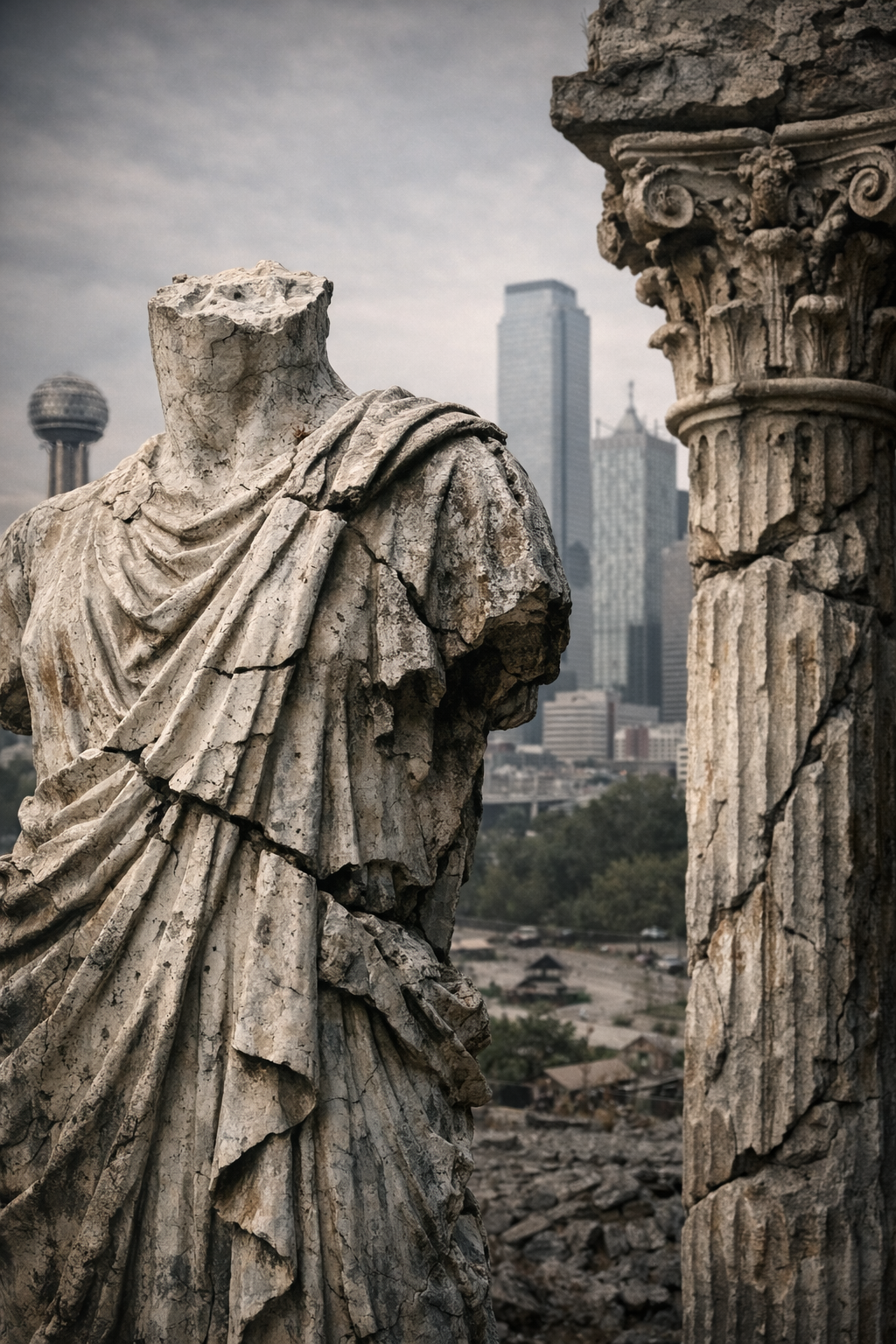
When civilizations fall, it is rarely because of a single moment or a single mistake. Rome did not collapse in one dramatic event. Neither did ancient Mesopotamia, Egypt, Maya, Greece, or China. Most societies do not disappear. They transform. Collapse, in its most common form, is not destruction. It is erosion.
History shows a consistent pattern. Decline comes from overlapping pressures that compound over time. Economic instability born from reckless policy. Military commitments that become too costly to sustain. Political corruption that erodes trust. Internal division that weakens cohesion. Environmental stress that accelerates scarcity. None of these alone ends a civilization. Together, they hollow it out until what remains looks intact but no longer functions as designed.
If the average lifespan of a civilization is roughly 336 years, the uncomfortable question is not whether decline is possible, but whether it is already underway. More importantly, is the decline accidental, or is it shaped by choices made without regard for long-term consequences?
The American Constitutional Republic did not accrue nearly $40 trillion in debt by coincidence. Leaders created it through repeated decisions to spend today and defer responsibility to tomorrow. Aid programs, foreign commitments, institutional expansion, and administrative overhead each seem justified in isolation. Together, they create a structure that cannot sustain itself.
Civilizations collapse because incentives become misaligned. Leaders protect systems that protect their power. Institutions defend themselves before their purpose. Over time, truth becomes less valuable than stability, and stability becomes less important than control. Decline begins through normalization.
Republics also fail when they assume all actors share the same motivations. Most people seek stability and continuity. Some seek power. A rare few seek authorship over disruption itself. History has always carried this spectrum. Builders, stewards, opportunists, and, occasionally, those who find purpose in collapse. Civilizations that survive do not deny this reality.
That is why guardrails matter. Transparent governance, where decisions leave visible records. Decentralized power, so no single ideology or authority can dominate. Economic accountability, where debt and incentives are understood rather than abstract. A culture that values dissent without rewarding chaos. An informed citizenry that recognizes when reform quietly becomes replacement. And a sober truth often avoided: no constitution, however well written, can restrain power if those entrusted to uphold it abandon restraint simultaneously.
When these guardrails weaken, division becomes a tool. Cultural conflict replaces structural scrutiny. People argue horizontally while power consolidates vertically. Accountability fades, not through force, but through distraction. The republic collapses gradually until it appears abrupt.
Republics fail when people stop protecting the principles that made them durable, when debt becomes normal, when division becomes strategy, and when institutions serve themselves before serving the public. When citizens assume everyone wants the republic to survive.
When you recognize that society’s tenets are hollowing out and its structure is wearing thin, a more complicated truth follows. By the time erosion becomes visible, the damage has already weakened the foundation beyond easy repair.
Leave a Reply