

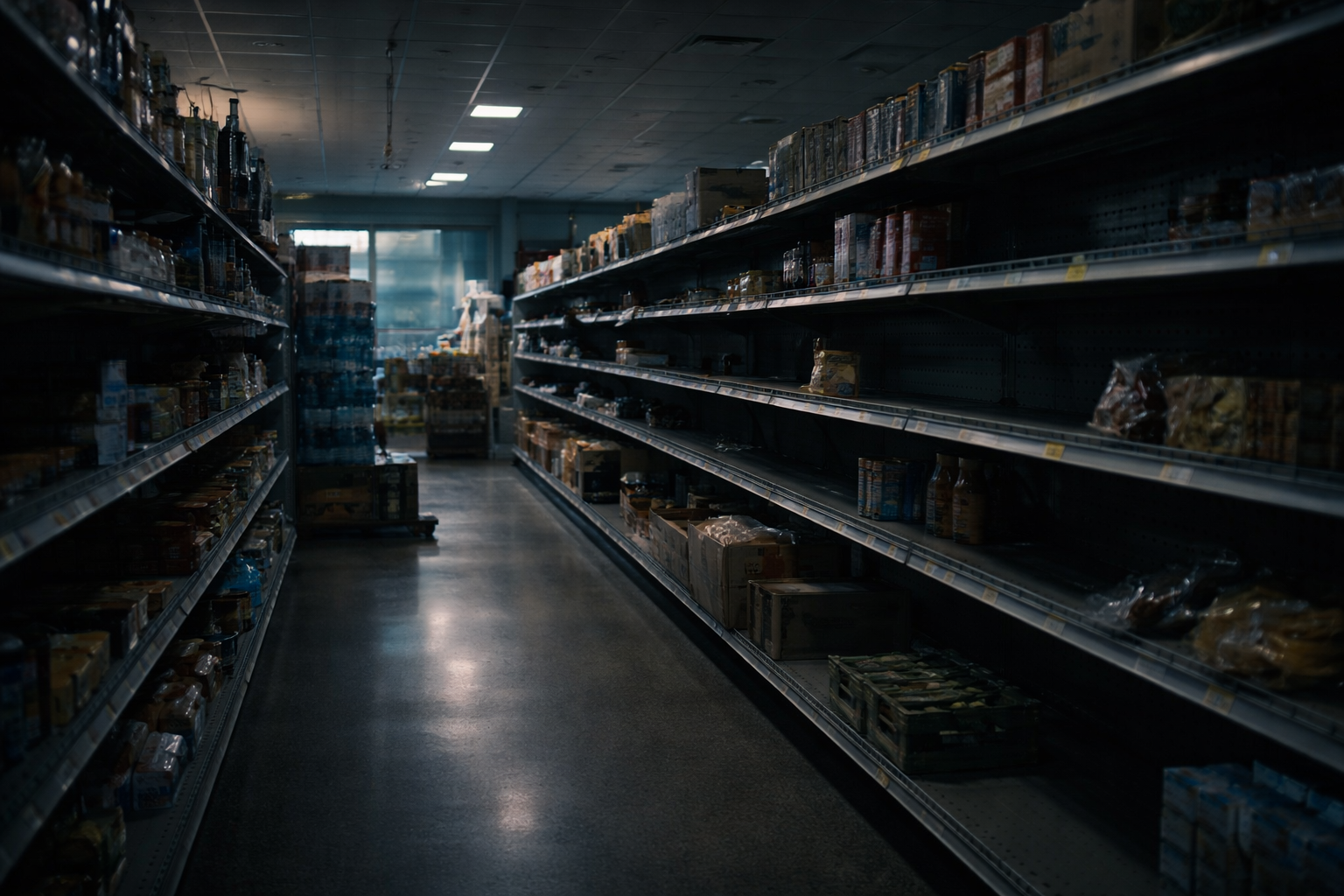
Envision a crisis unfolding. The shelves are still full. Groceries stacked neatly. Fuel available. Delivery trucks still moving. For a few hours, maybe even a day, the illusion of stability holds.
The stores are crowded. Anticipation hangs in the air.
Then the shelves thin. Not suddenly, just lighter. Certain brands disappear. Substitutes fill their place. By the second day, the restocking trucks haven’t arrived. By the third, managers stop offering answers. They are waiting on updates from regional distribution centers that are themselves waiting on confirmation from somewhere farther upstream.
Modern retail runs on just-in-time logistics. Inventory is not stored in excess. Warehouses carry calculated volume based on predictive models, not buffers. Trucks stay in motion. Supply meets demand because both are forecasted. Efficiency replaced redundancy long ago.
If demand spikes beyond projections, or if transportation pauses, even briefly, the system does not flex. It stalls.
Most households have roughly seventy-two hours before discomfort turns into anxiety. Food, fuel, medicine, and digital payment systems are interconnected. A grocery store depends on its regional hub. That hub depends on manufacturers. Manufacturers rely on raw materials. Raw materials depend on shipping lanes, energy inputs, and labor continuity. Each link assumes the others will function.
Convenience quietly became dependence.
When shipments stop, people wait. Then they improvise. Then they ration. Hunger shifts temperament faster than ideology ever could. Sleep degrades. Trust thins. Minor disagreements become territorial.
The system doesn’t need to collapse all at once to feel fragile. It can tighten gradually. Fewer product choices. Delayed deliveries. Purchase limits introduced as “temporary.” Shelves never look catastrophic. They just never look full again.
And new layers form.
Certain buyers are prioritized. Certain routes remain open. Some stores stay stocked while others do not. Access becomes uneven, not always through malice, often through triage.
Resilience is invisible until it is called.
In that moment, character surfaces. The person with a stocked pantry becomes a steward or a hoarder. The store manager becomes a communicator or a gatekeeper. The neighbor becomes a partner or a competitor.
A nation rarely crumbles from a single blow. It falters when its hidden systems strain beyond their design and the people inside them realize how little slack remains.
Scarcity does not create character. It reveals it.
Leave a Reply